By Maxime Roblot, Head of Sales and Business Development, Kill Bill. Last updated: 4 October 2026.
Short answer
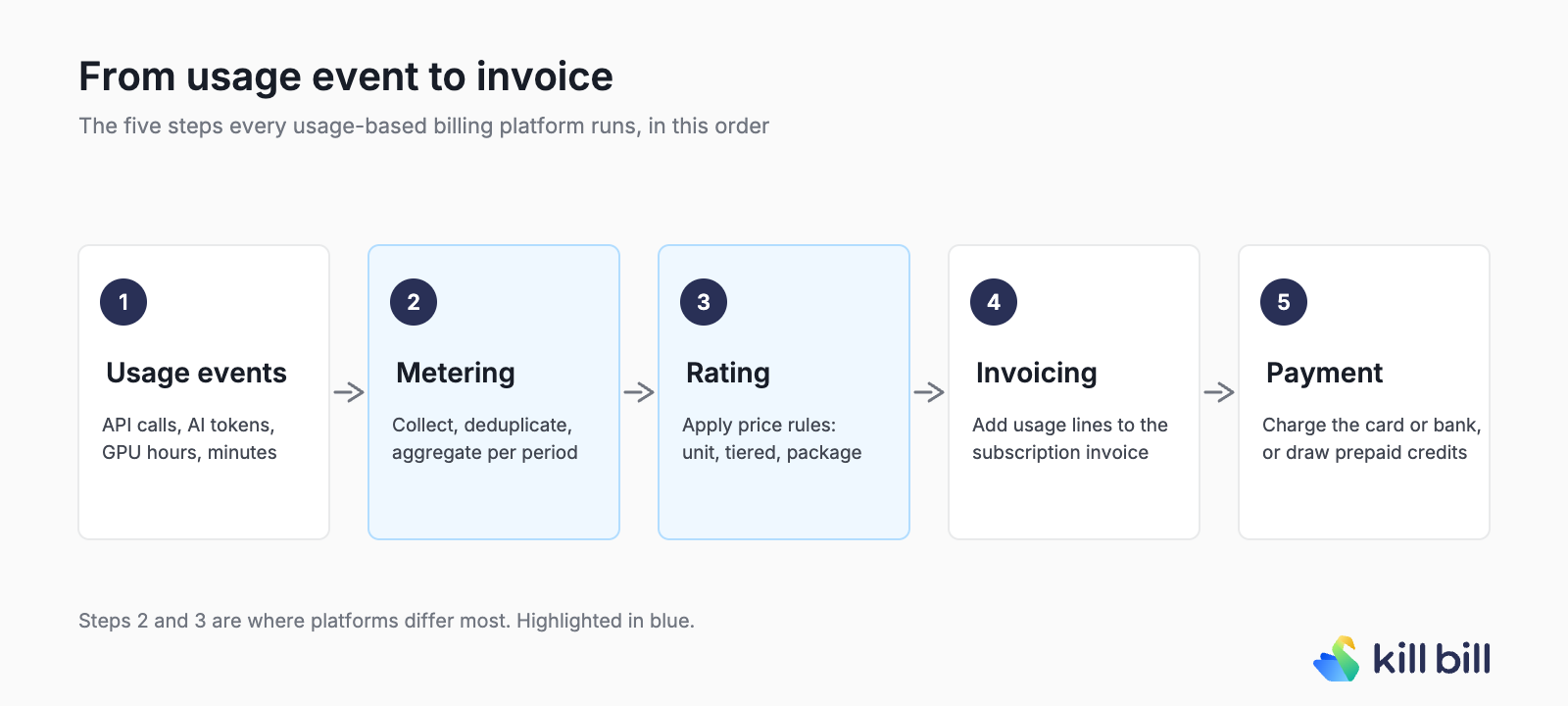
A usage-based billing platform turns raw usage, such as API calls, AI tokens, GPU hours or minutes parked, into priced lines on a customer invoice. It does this in five steps: it collects usage events, aggregates them per billing period, prices them with rules from a catalog, adds the result to the invoice, and collects payment.
To choose one, ask eight questions: how events get in, which pricing models the catalog supports, whether one account can carry a subscription and usage, how prepaid credits work, whether a price can depend on event attributes, which payment and tax providers you can plug in, where revenue recognition stands, and where the platform runs.
Aviate is the enterprise accelerator for Kill Bill: a control plane with additional features and support included, for a fixed price that does not change with your revenue. It covers usage events, unit, tiered and package pricing, hybrid subscription and usage accounts, prepaid credits with automatic top-off, and rule-based rating. It runs on Kill Bill, an open-source billing platform in production since 2010, on infrastructure you choose.
What does a usage-based billing platform do?
Usage-based billing charges customers for what they consume during a period instead of, or on top of, a fixed fee. Common units are API calls, AI tokens, compute hours, storage, messages, kilowatt-hours and parking minutes.
Two terms come up in every evaluation. Metering is the collection and aggregation of usage events. Rating is the step that applies prices to the aggregated quantities. A platform can be strong on one and weak on the other, so test both.
1. How do usage events get into the platform?
Usage reaches the billing platform as events sent by your application, usually through an API, each with an account, a unit, a quantity and a timestamp. The platform stores them and aggregates them for the billing period.
In Aviate, your application submits usage events through the Aviate APIs, and the usage is aggregated and invoiced at the end of each billing period. The usage tutorial walks through an AI token example from catalog to invoice.
What to ask a vendor:
- What happens when the same event is sent twice?
- Can events arrive late, after the period has closed, and how are they billed?
- Can you see the raw events behind an invoice line when a customer disputes it?
2. Which pricing models can the catalog rate?
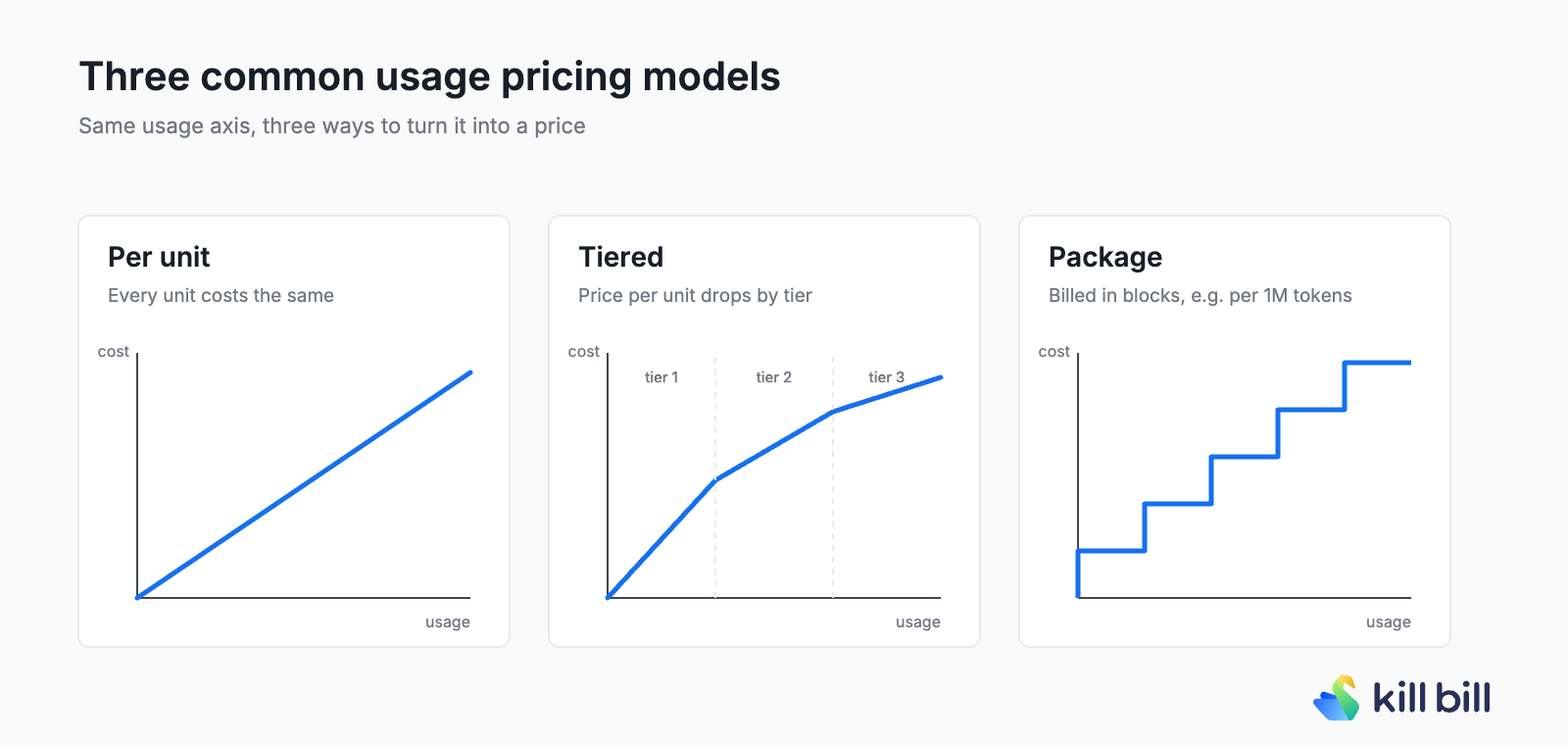
Most usage pricing falls into three models. Per unit charges the same price for every unit. Tiered pricing changes the unit price as usage crosses thresholds. Package pricing bills usage in blocks, for example per million tokens, and rounds up to the next block.
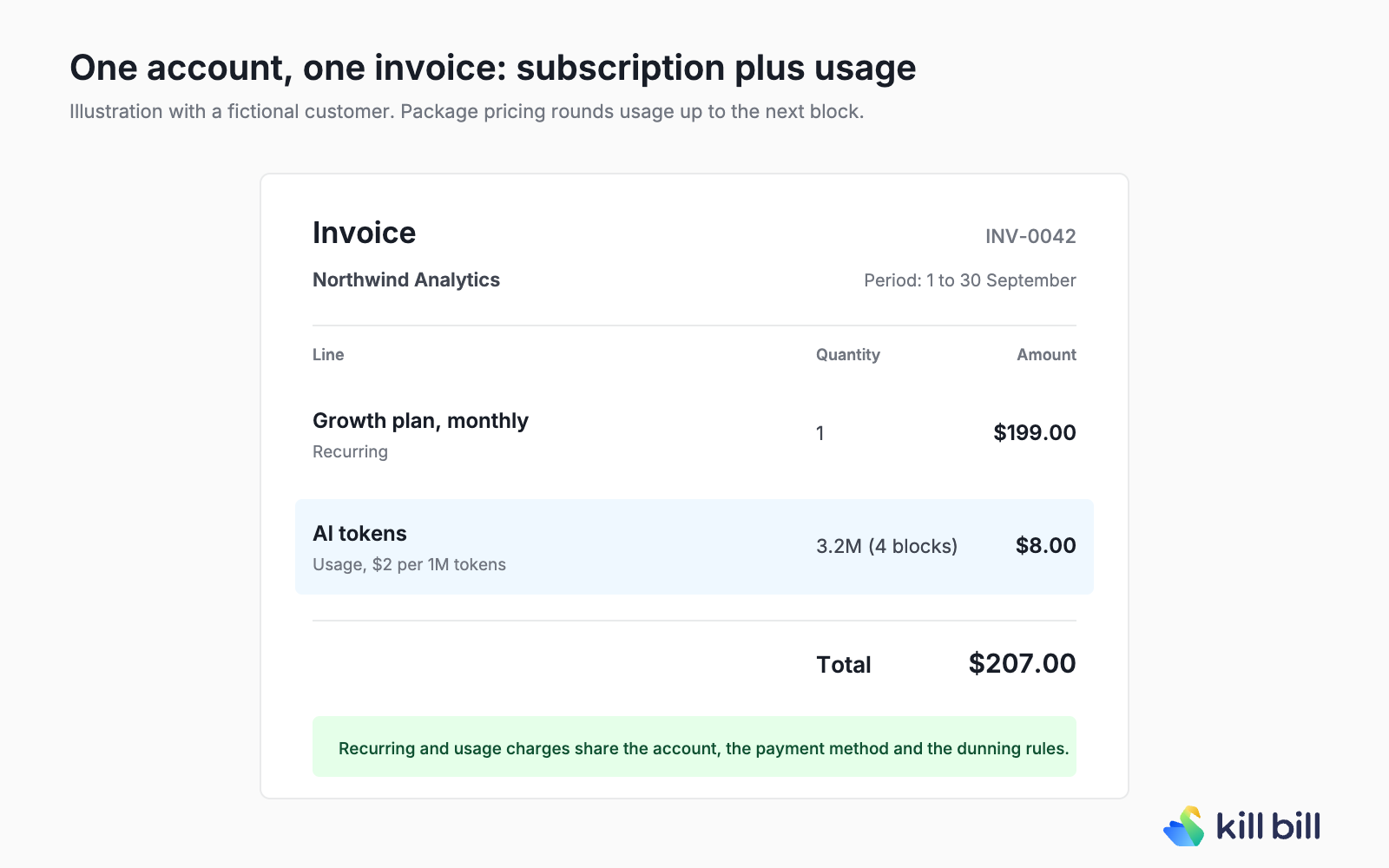
The Kill Bill catalog supports unit, tiered and package pricing for usage. The AI tutorial uses package pricing at $2 per million tokens.
What to ask a vendor:
- Can you change a price on a date without touching invoices already issued?
- Can two customers on the same plan have different rates?
3. Can one account carry a subscription and usage?
Yes, on most platforms built for it, and it is the most common model in practice: a fixed monthly fee for access, plus usage on top. The test is whether both land on the same account, the same invoice and the same payment and dunning rules, or whether you end up reconciling two systems.
In Kill Bill, and so in Aviate, each invoice of a hybrid plan carries both items: the recurring fee, charged in advance, and the usage, charged in arrears once the quantity for the period is known (usage billing guide).
4. How do prepaid credits work?
With prepaid credits, the customer buys a balance up front and usage draws it down. It is the model behind phone top-ups, and many AI products now sell tokens the same way. It protects the seller from unpaid usage and gives the buyer a spending limit they can see.
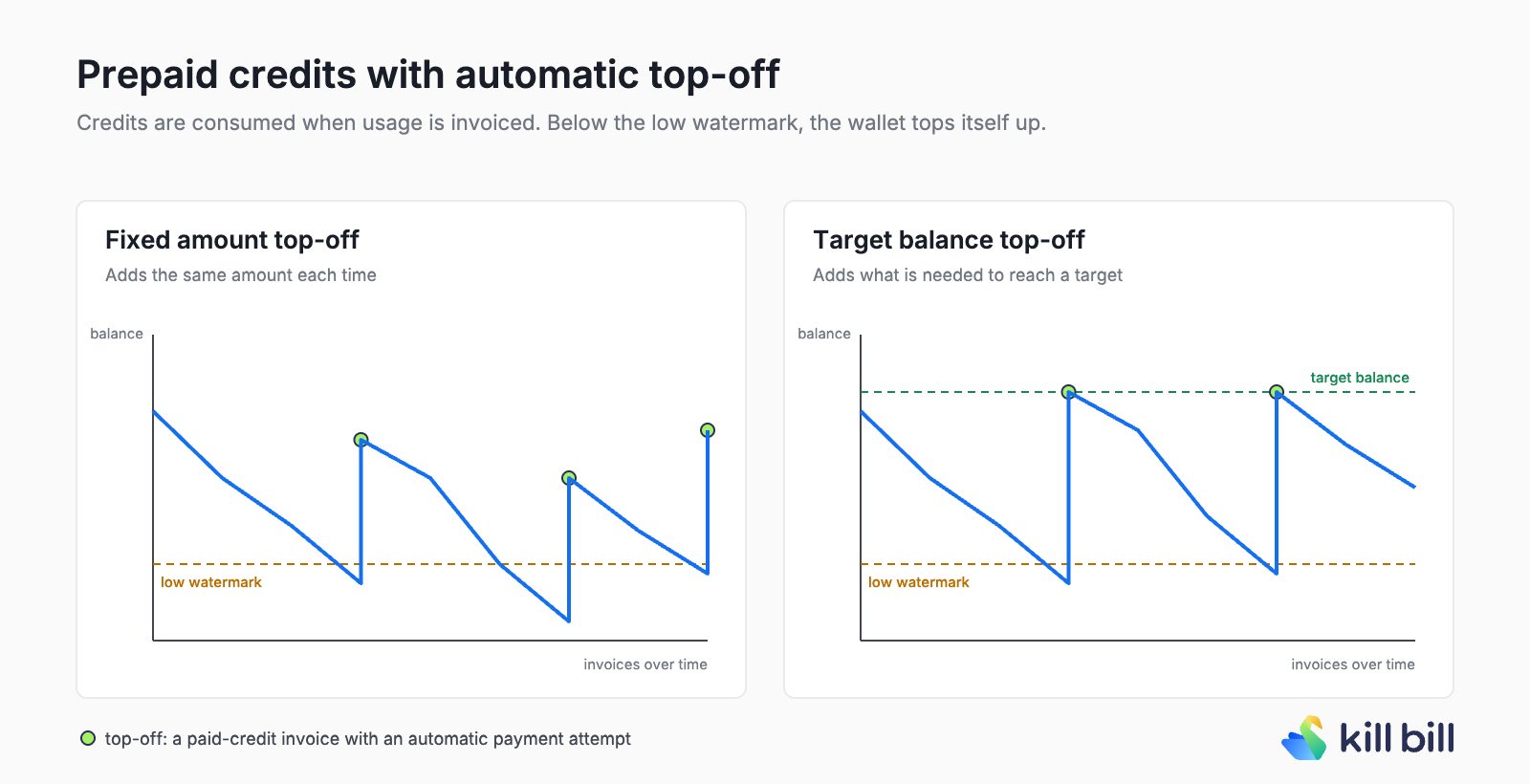
The Aviate Wallet keeps a credit balance per account, with paid credits and free promotional credits tracked separately. Credits are consumed when usage is invoiced. When the balance falls below a low watermark, the wallet tops itself up in one of two ways: a fixed amount each time, or whatever is needed to reach a target balance. Each top-off creates a paid-credit invoice with an automatic payment attempt. Credits can carry an expiry date.
What to ask a vendor:
- What happens when the balance reaches zero: service stops, the balance goes negative, or the card on file is charged?
- Do free credits get consumed before paid ones?
- How are expired credits shown to the customer and to finance?
5. Can a price depend on event attributes?
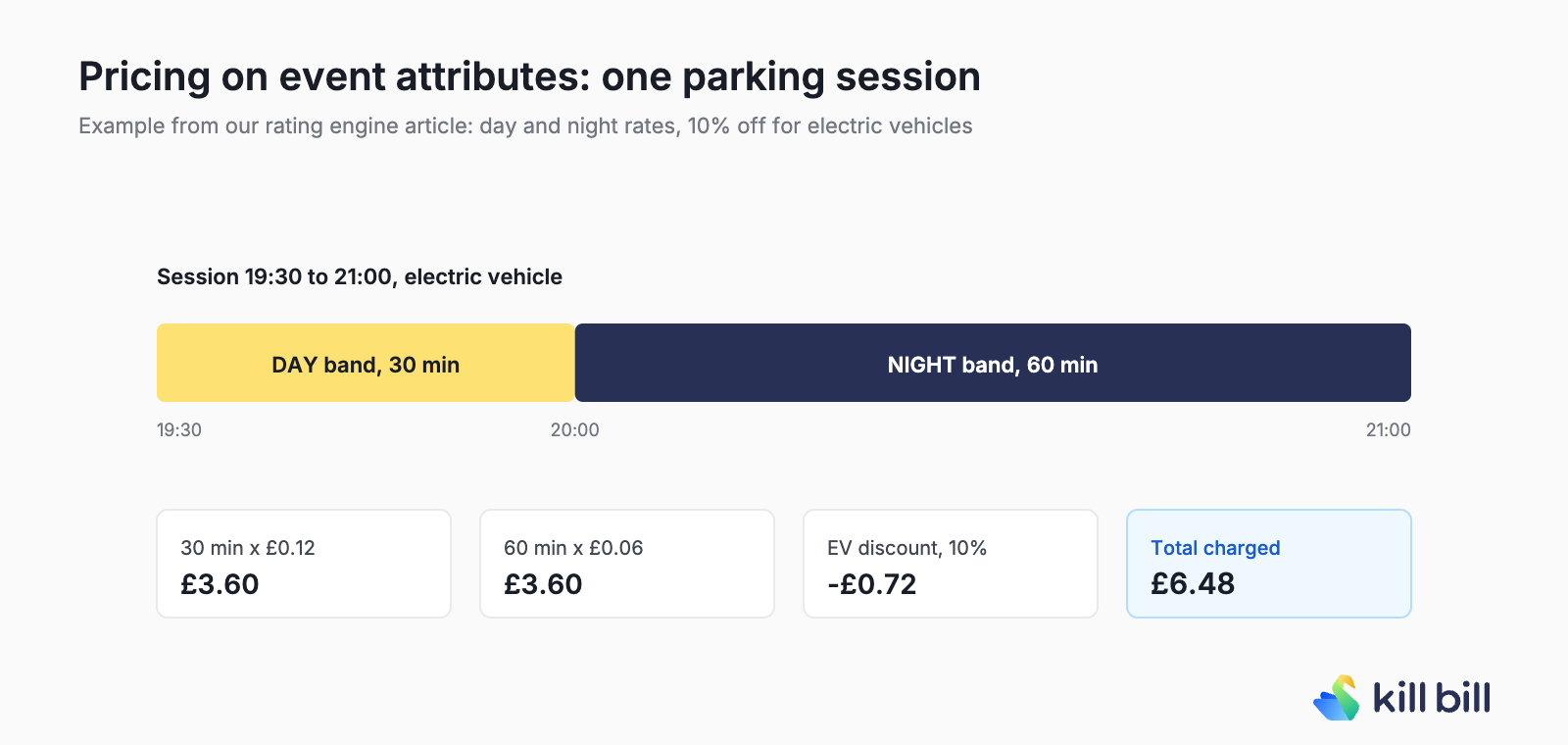
Some prices depend on more than a quantity: the time of day, the type of vehicle, the region, the customer segment. A catalog of plans struggles with this. A rating engine prices each event from its attributes.
Aviate includes a rating engine where selectors and formulas are written as JavaScript expressions over the event attributes. A quote endpoint returns the price without charging, which serves as a dry run. A charge endpoint posts the amount to the customer’s Kill Bill invoice. Rating catalogs are versioned, so a new rate card applies from the moment it is activated. Our article on real-time usage rating walks through the parking example below.
6. Which payment and tax providers can you plug in?
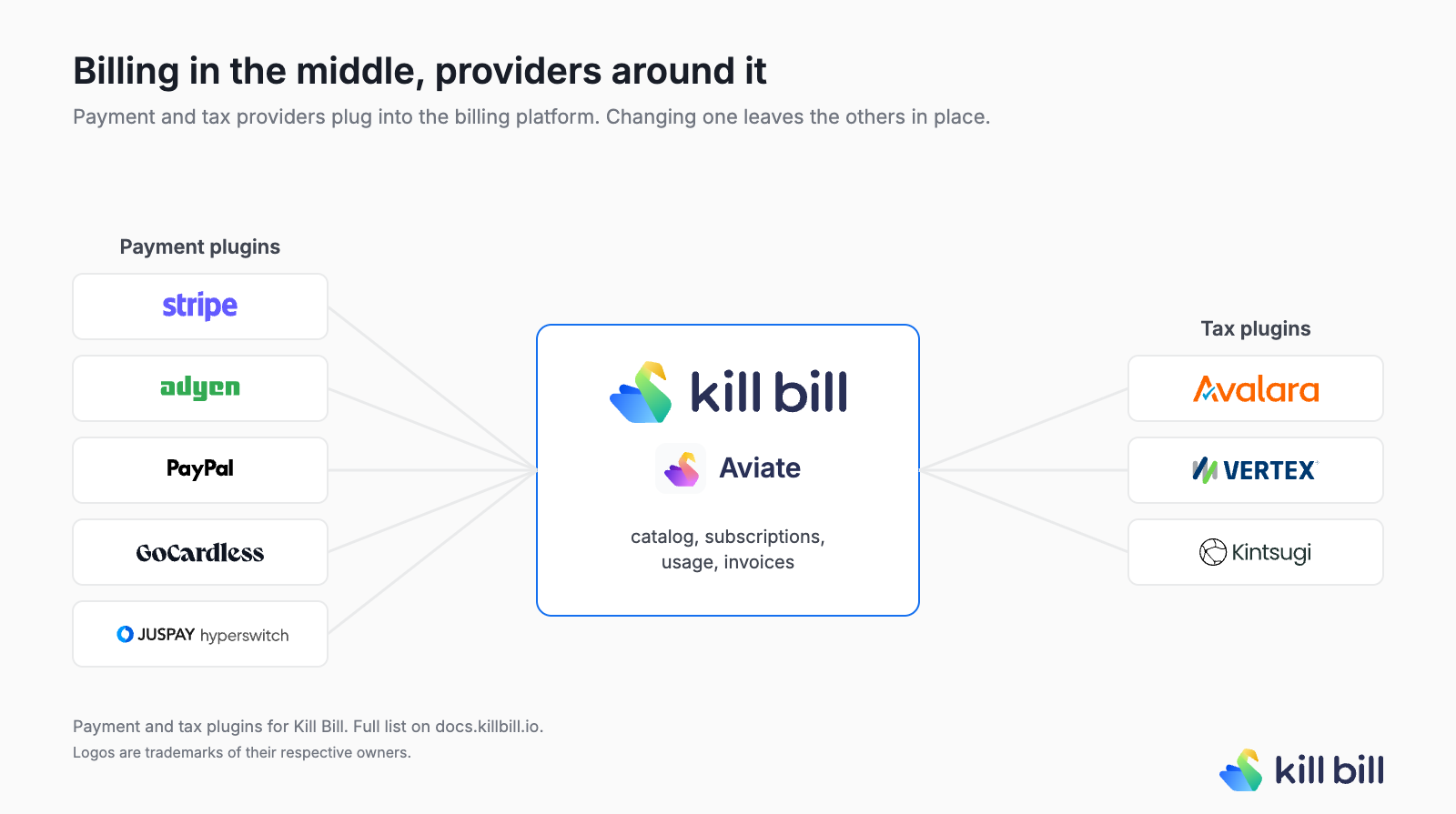
Billing decides what to charge. A payment provider moves the money and a tax engine computes the tax. If the billing platform is tied to one payment provider, changing provider later means changing billing too.
Kill Bill connects to providers through plugins. Payment plugins include Stripe, Adyen, PayPal, GoCardless and Hyperswitch. For tax, the Avalara AvaTax plugin calculates tax during invoice generation and adds the tax items to the invoice. Vertex and Kintsugi plugins are also available.
The question carries more weight in 2026, because several usage billing vendors now belong to larger groups. Metronome is part of Stripe. Adyen completed its acquisition of Orb on 1 July 2026 (Adyen). m3ter is part of Salesforce. Ask each vendor how its support for other payment providers will evolve.
7. Where does revenue recognition stand?
Usage revenue is recognized as it is consumed, which makes it harder to schedule than a flat subscription. Finance teams under ASC 606 or IFRS 15 will ask how invoice amounts become revenue per period.
Ask for a demo of the full path from usage event to revenue entry, not only the invoice. On Aviate, revenue recognition is in testing with early users.
8. Where does the platform run, and who holds the data?
Hosted platforms run in the vendor’s cloud. Self-hosted platforms run in yours. The choice affects data residency, security reviews, latency for high event volumes and what happens if you change vendor.
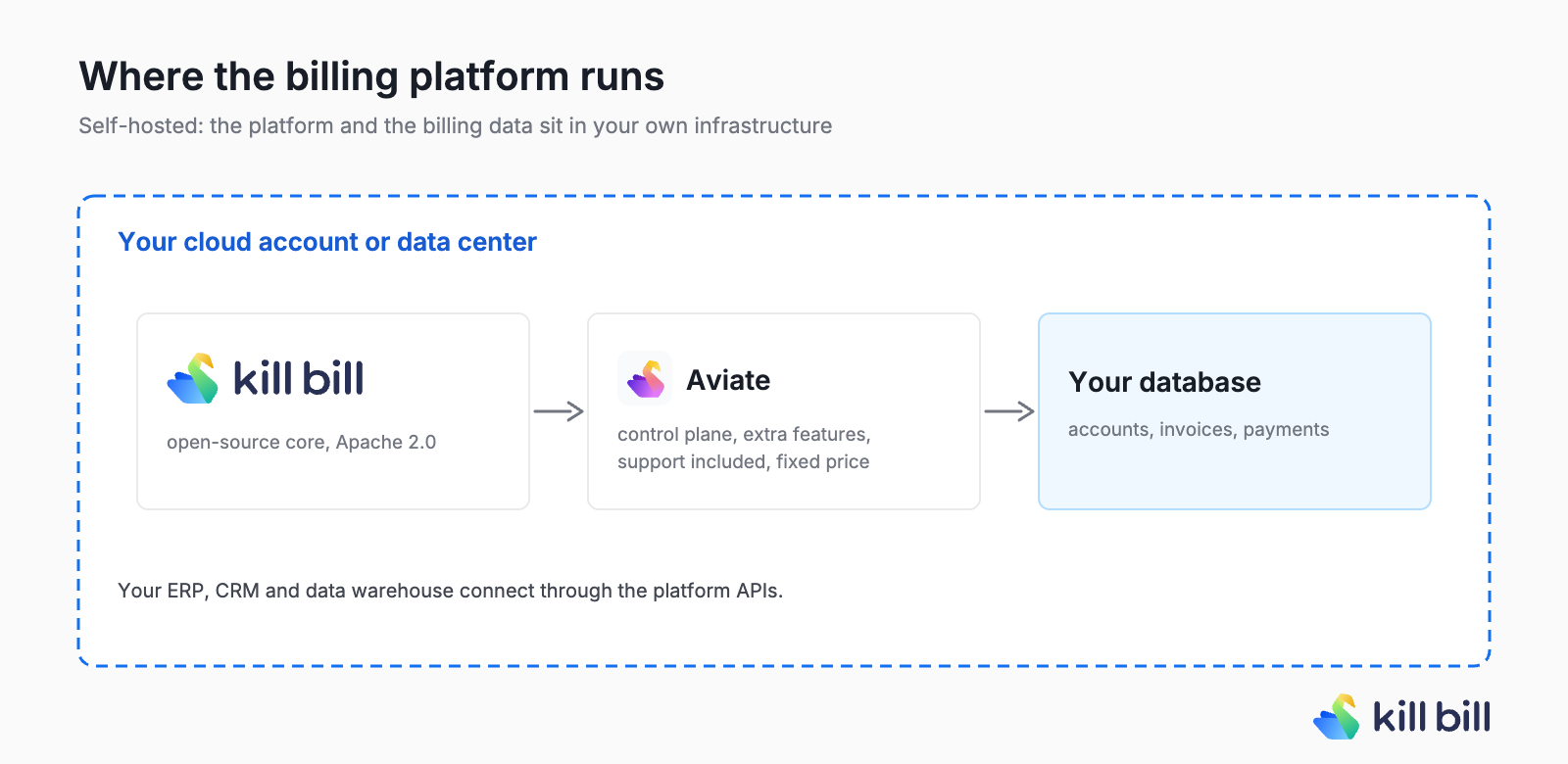
Kill Bill is open source under the Apache 2.0 license and runs in your own cloud account or data center. Aviate is the enterprise accelerator on top of it: a control plane with additional features, with support included, for a fixed price that does not change with your revenue. It runs as a plugin on that deployment, so the billing data stays in your database. Support is Level 3, from Kill Bill engineers on a dedicated Slack channel.
What to ask a vendor:
- Where does the billing data sit, and how would you take it with you if you leave?
- Does the price grow with your billing volume or revenue, or is it fixed?
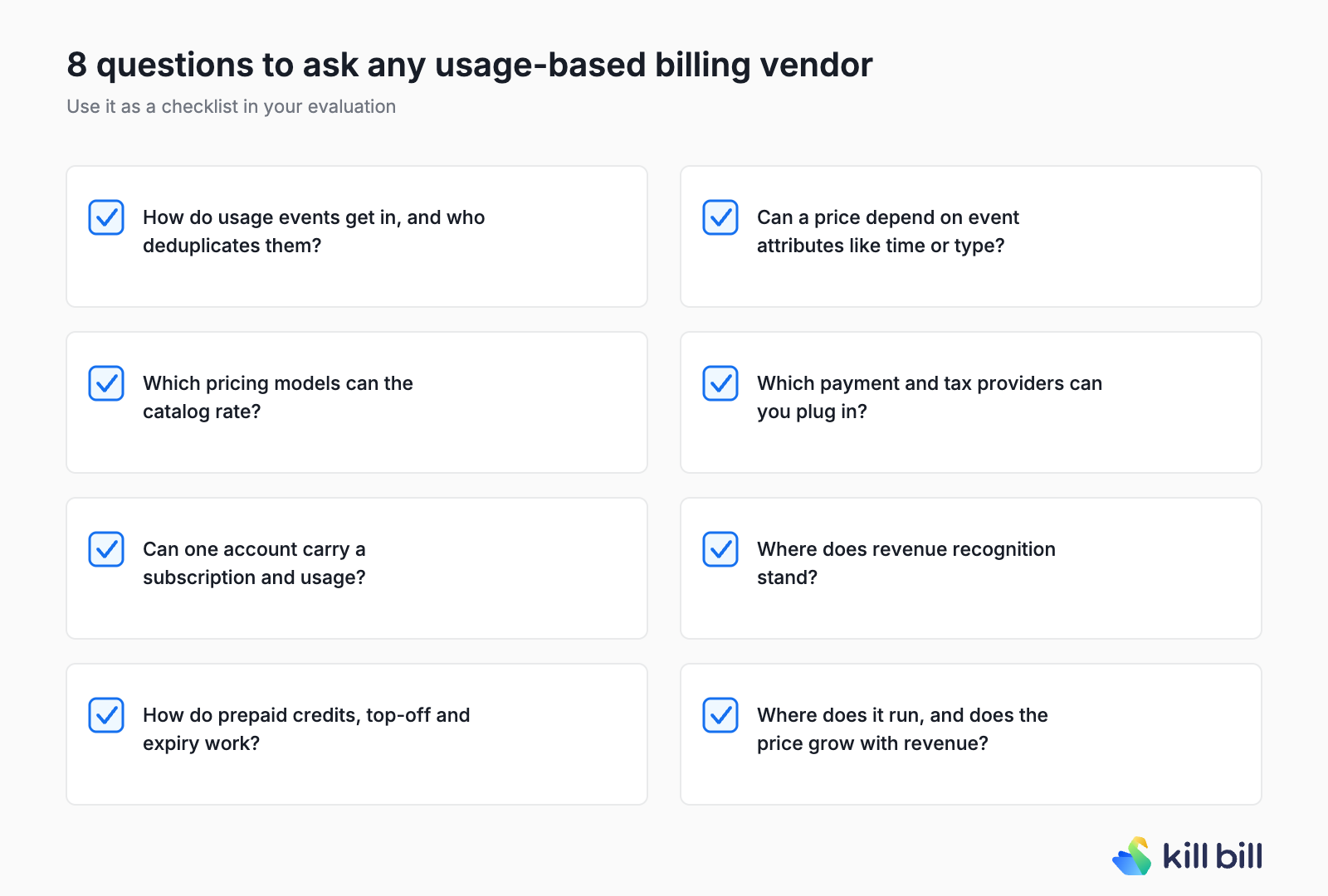
Checklist: 8 questions to ask a usage-based billing platform vendor
| Question | What a good answer includes |
|---|---|
| 1. How do usage events get in? | An API, a rule for duplicate and late events, raw events visible behind each invoice line |
| 2. Which pricing models? | Unit, tiered and package pricing, dated price changes, per-customer rates |
| 3. Subscription and usage on one account? | One invoice, one payment method, one set of dunning rules |
| 4. Prepaid credits? | Balance per account, automatic top-off, expiry, a defined behavior at zero |
| 5. Pricing on event attributes? | Rules on time, type or region, a dry run before charging, versioned rate cards |
| 6. Payment and tax providers? | Several payment and tax options, no lock-in to one provider |
| 7. Revenue recognition? | A demonstrated path from usage to revenue entries, with its current status |
| 8. Deployment, data and pricing basis? | Hosted or self-hosted, where the data sits, how you would leave, whether the price grows with your revenue |
Frequently asked questions
What is the difference between metering and rating?
Metering collects and aggregates usage events. Rating applies prices to the aggregated quantities. Both are needed to produce a usage invoice line.
Can a company combine a subscription and usage-based pricing?
Yes. A common model is a fixed monthly fee plus metered usage on the same account and invoice. Aviate, the enterprise billing solution from Kill Bill, supports this hybrid model.
How do prepaid credits work in usage-based billing?
The customer buys credits up front and usage draws them down. In Aviate, credits are consumed when usage is invoiced, and the wallet tops itself up automatically below a low watermark, by a fixed amount or up to a target balance.
Is there an open-source usage-based billing platform?
Yes. Kill Bill is an open-source billing and payments platform under the Apache 2.0 license, in production since 2010, with usage billing in its catalog. Aviate is the enterprise accelerator built on it, with support included and a fixed price. Other open-source options, such as Lago and Flexprice, are listed in the references below.
Can usage be priced on time of day or other event attributes?
Yes, with a rating engine. Aviate’s rating engine prices each event with rules written as JavaScript expressions over the event attributes, such as day and night rates or a discount for a vehicle type.
Which usage-based billing platforms now belong to larger groups?
Metronome is part of Stripe. Adyen completed its acquisition of Orb on 1 July 2026. m3ter is part of Salesforce.
Other usage-based billing platforms, as of 4 October 2026
Descriptions taken from each vendor’s own website on 3 and 4 October 2026, in alphabetical order.
- BillingPlatform: a usage-to-cash platform for enterprises, covering subscription, recurring and usage-based billing.
- Chargebee: billing, pricing and revenue operations, from subscriptions to usage-based monetization.
- Flexprice: usage-based, credit-based and hybrid pricing with real-time metering; open-source core under the AGPLv3 license, self-hosted or cloud.
- Lago: open-source billing for usage, subscriptions and hybrid pricing, under the AGPLv3 license, self-hosted or managed.
- m3ter: usage-based billing infrastructure, now part of Salesforce.
- Metronome: a usage-based billing platform, now part of Stripe.
- Orb: a platform to automate usage-based billing and pricing; Adyen completed its acquisition on 1 July 2026 and says Orb keeps supporting several payment providers in a first phase.
- Solvimon: billing and revenue management for usage-based, outcome-based and hybrid pricing.
- Stripe Billing: usage-based and hybrid models, with Metronome offered as an add-on for advanced cases.
- Zuora: billing for subscriptions and usage, with built-in mediation and rating of usage events.
Sources
- Kill Bill documentation: Usage tutorial, AI use case
- Kill Bill documentation: Usage billing, consumable in arrear
- Kill Bill documentation: Aviate Wallet
- Kill Bill documentation: AvaTax plugin
- Kill Bill documentation: Kintsugi plugin
- Kill Bill blog: Real-time usage rating with Aviate
- Adyen: Adyen completes acquisitions of Talon.One and Orb