By Maxime Roblot, Head of Sales and Business Development, Kill Bill. Last updated: 22 September 2026.
Short answer
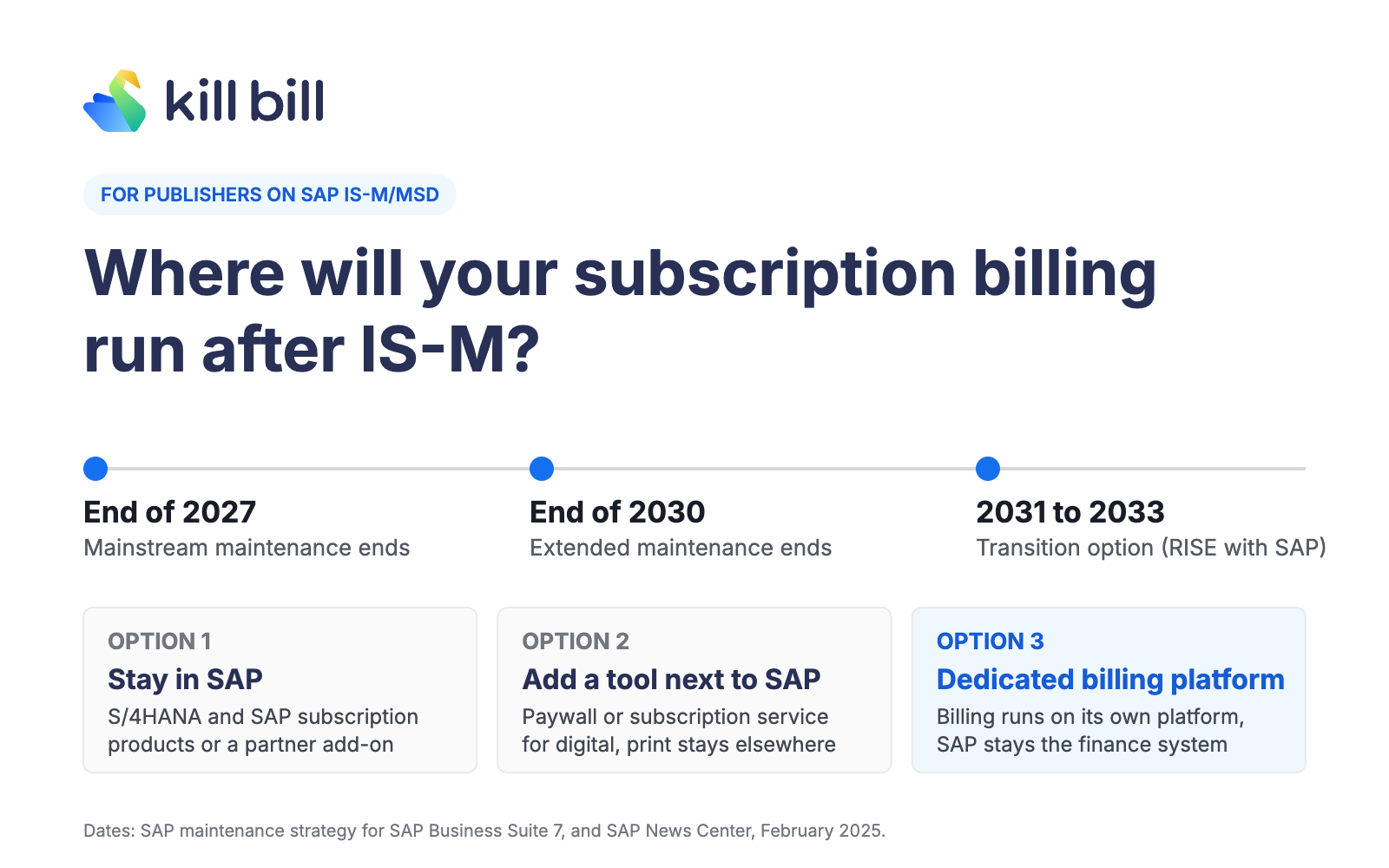
SAP IS-M (SAP for Media) is the SAP ECC industry solution that many European publishers use to run print and digital subscriptions, delivery and subscription billing. SAP ends mainstream maintenance for SAP Business Suite 7, which includes ECC, at the end of 2027, with optional extended maintenance until the end of 2030 (SAP maintenance strategy).
Publishers that still run subscriptions on IS-M therefore need to decide where subscription billing will run after ECC.
There are three main paths: move the subscription processes into SAP S/4HANA and SAP’s own subscription products, add a paywall or subscription tool next to SAP, or run subscription billing on a dedicated billing platform and keep SAP as the finance system.
Aviate, the enterprise subscription billing solution from Kill Bill, is built for the third path.
What is SAP IS-M/MSD?
IS-M is the SAP industry solution for media companies on SAP ERP (ECC). Its sales and distribution part, IS-M/SD, is also referred to as MSD. It covers subscription orders, delivery and logistics for print, customer service processes and subscription billing. Its advertising part, IS-M/AM, covers advertising sales.
SAP delivers IS-M as an industry solution for SAP ERP 6.0 (IS-M release notes for SAP ERP 6.0).
According to the public reference lists of SAP consulting firms that specialise in media, IS-M/SD is used mostly by newspaper and magazine groups in Germany, Austria and Switzerland, with some users in other European countries.
What changes in 2027, 2030 and 2033?
SAP has published the following maintenance dates for SAP Business Suite 7, which includes ECC and therefore the ECC-based industry solutions:
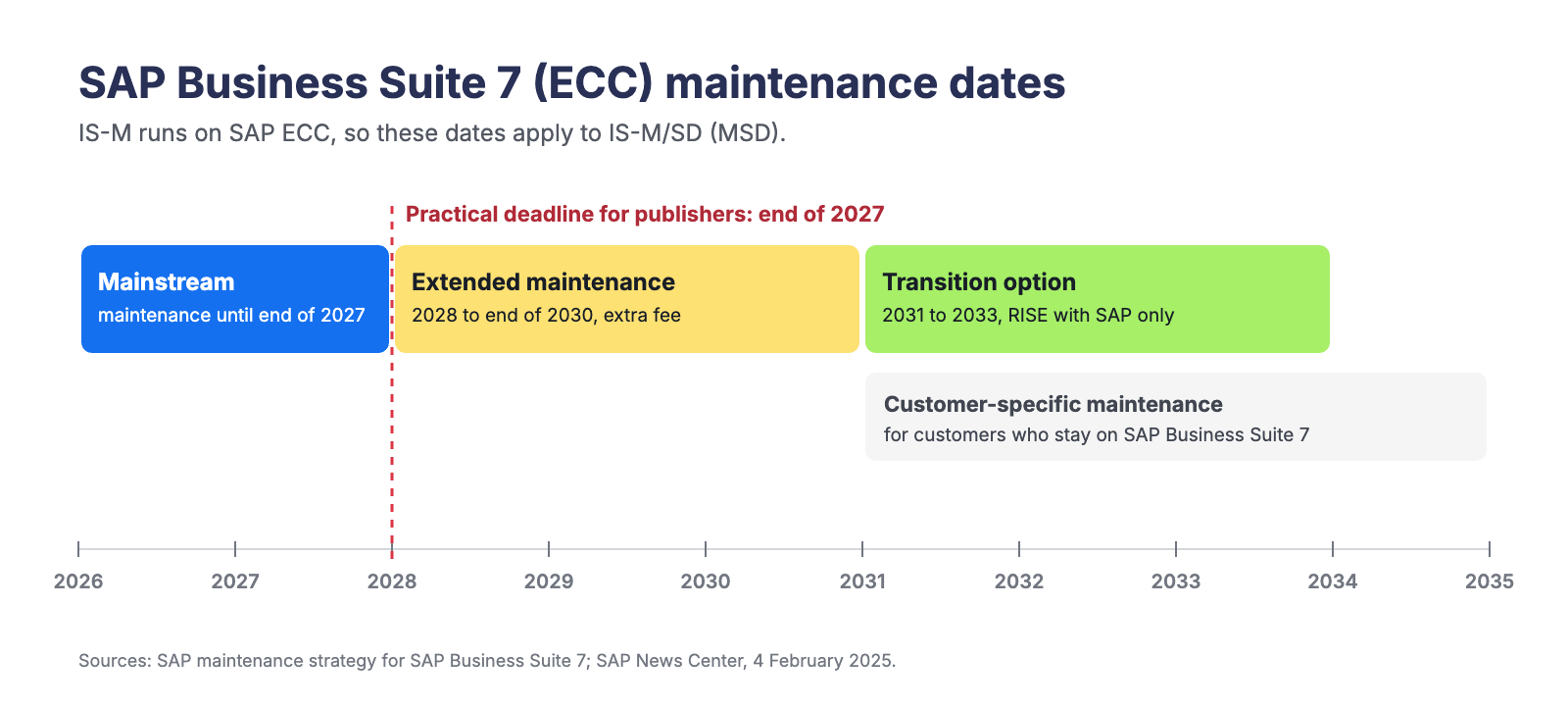
- End of 2027: end of mainstream maintenance for SAP Business Suite 7 core applications.
- 2028 to end of 2030: optional extended maintenance for SAP Business Suite 7, for an additional fee.
- After 2030: extended maintenance ends, and customers who stay on SAP Business Suite 7 without the transition option receive customer-specific maintenance.
- 2031 to end of 2033: the SAP ERP, private edition, transition option, a cloud subscription for large SAP ERP customers who move to SAP ERP private edition before the end of 2030 as part of RISE with SAP. SAP says it does not cover the full scope of SAP Business Suite 7.
For a publisher, the practical deadline is the end of 2027. After that date, running IS-M on ECC means paying for extended maintenance, accepting customer-specific maintenance, or having a migration already under way.
Is IS-M/MSD part of SAP S/4HANA?
Not as a successor product. DXC Technology, an SAP partner that works on media migrations, states that the IS-Media functions stay at their old release level in all three SAP S/4HANA deployment options (on-premise, private cloud and public cloud), and that there is no direct successor solution (DXC Technology, September 2025).
SAP partners that sell media add-ons for S/4HANA make the same point about standard S/4HANA. SAP has moved the media product master to S/4HANA (SAP blog, 2017), and the SAP simplification list for each S/4HANA release has an item called “SAP Media availability in SAP S/4HANA”. Check that item for your target release with SAP or your SAP partner before you plan the migration.
What is happening in European media right now?
At Kill Bill we see a trend in the European media vertical. In 2026, we have been in conversations with several European publishers about their subscription billing, and the questions come up in the same order: how to leave an older subscription system, how to keep SAP as the finance system, and how to handle more complex offers.
Public announcements show the same direction. Publishers are selling bundles across titles and even across companies.
In 2025, an Austrian national daily started a combined subscription with a large US newspaper. In 2026, two Danish media groups launched one digital subscription that gives access to more than 20 titles. Regional groups are also bringing several titles together on shared platforms and shared reader market teams.
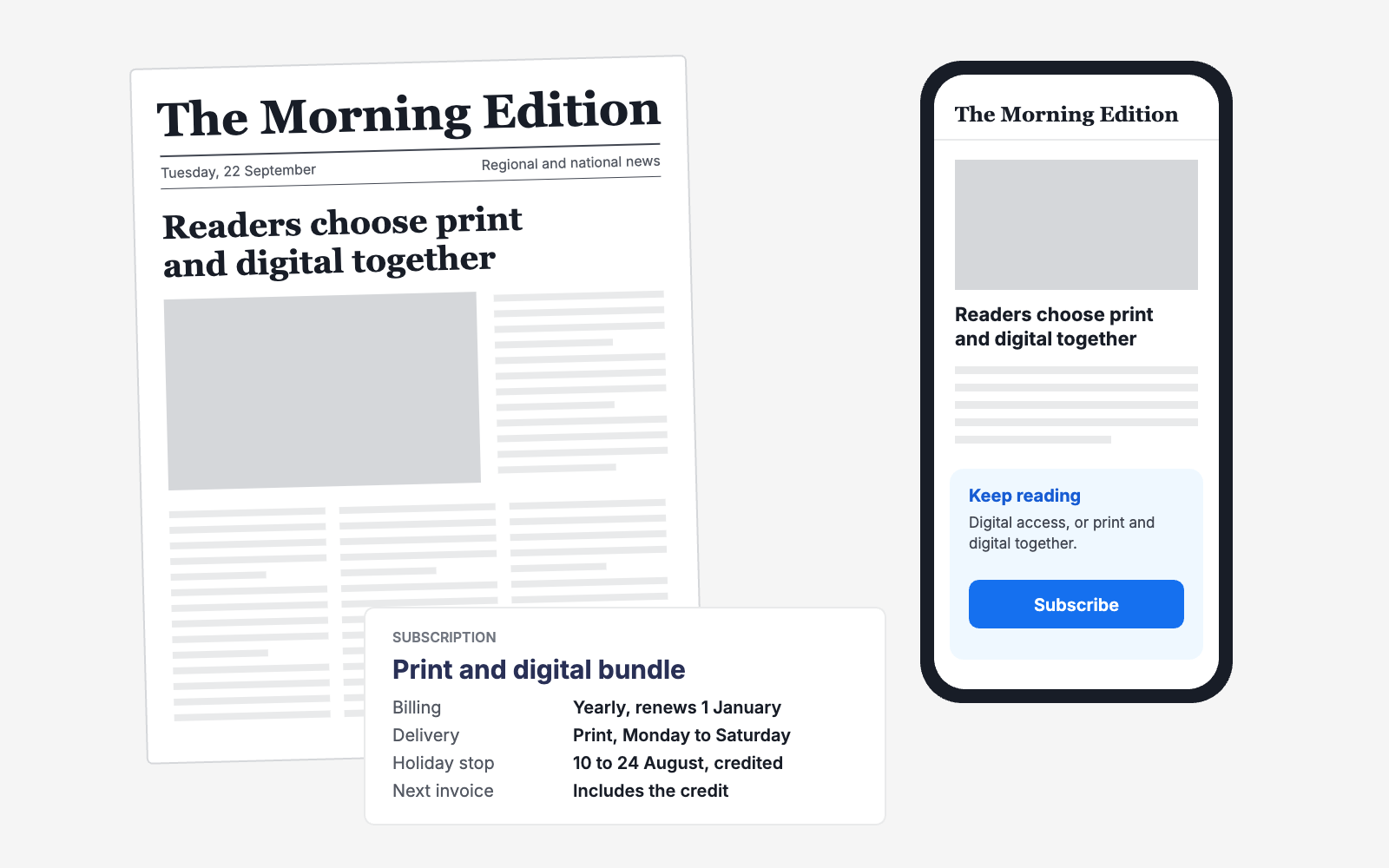
Bundles, shared platforms and new digital products all ask more of the billing system than a print subscription did. This is happening at the same time as the ECC deadline, and the publishers we talk to now review subscription billing as a decision of its own.
What are the options for subscription billing after IS-M?
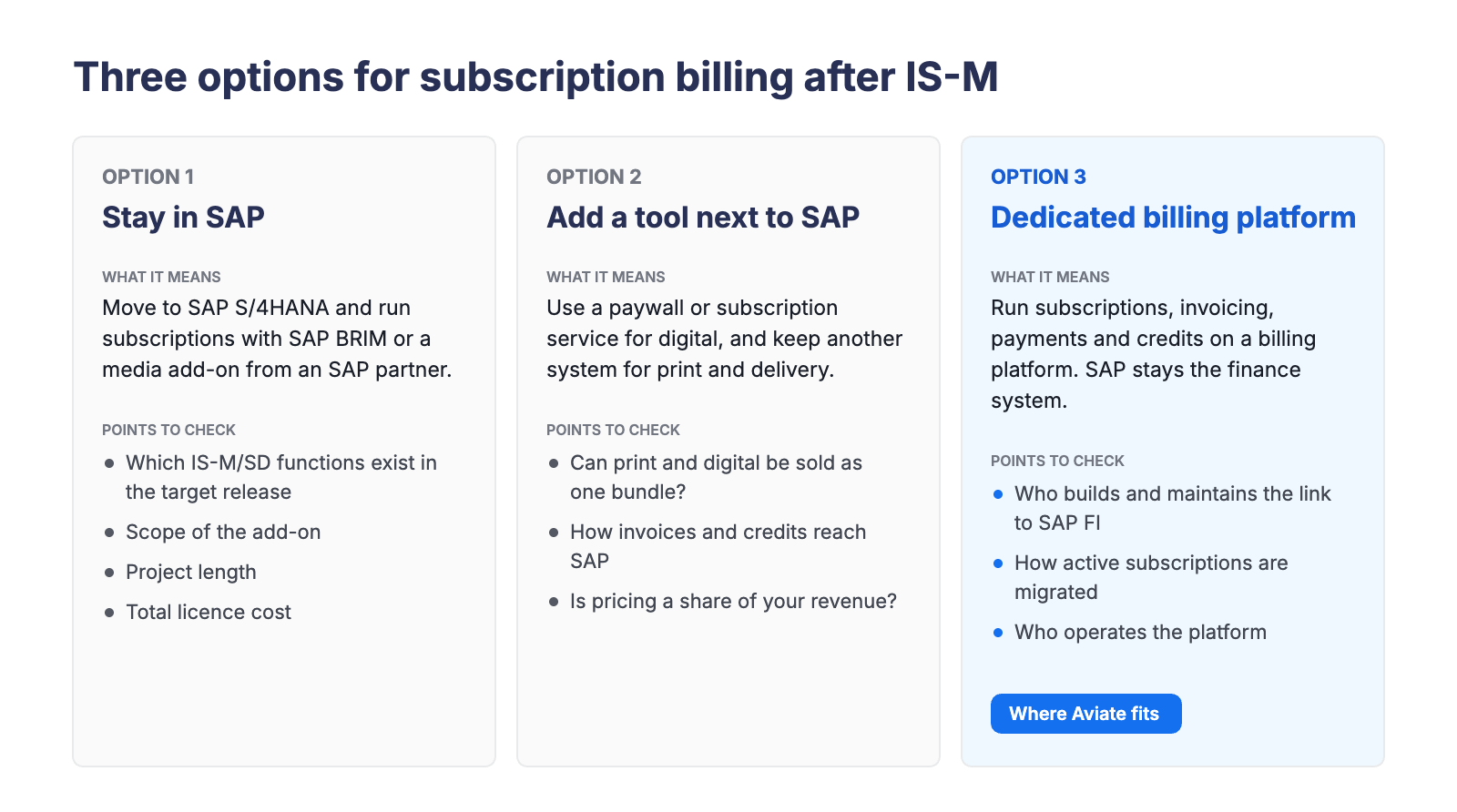
- Option 1, stay in SAP: move to SAP S/4HANA and run subscriptions with SAP Billing and Revenue Innovation Management (BRIM) or with a media add-on from an SAP partner. Check which IS-M/SD functions exist in the target release, the scope of the add-on, the project length and the total licence cost.
- Option 2, add a subscription tool next to SAP: use a paywall or subscription service for digital subscriptions, and keep another system for print and delivery. Check whether print and digital can be sold as one bundle, how invoices and credits reach SAP, and whether pricing is a share of your revenue.
- Option 3, use a dedicated billing platform and keep SAP for finance: run subscriptions, invoicing, payments and credits on a billing platform, and send the accounting results to SAP. Check who builds and maintains the link to SAP FI, how active subscriptions and renewal dates are migrated, and who operates the platform.
No option fits every publisher. A group with a large SAP team and a wide IS-M footprint may prefer to stay in SAP. A publisher whose growth is mostly digital may look at options 2 or 3.
What should a publisher check before choosing?
- Offers: print, digital and combined subscriptions, bundles with other titles or partners, trial periods, and price increases on existing subscribers.
- Changes during a subscription: holiday stops for print delivery, upgrades and downgrades, pro rata charges, and cancellation of a prepaid annual subscription with a credit.
- Legal entities, currencies and tax: several publishing companies in one group, several currencies, and VAT rules per country.
- Finance: which system issues the legal invoice, how invoices, payments, credits and refunds are posted to SAP FI, and how the monthly closing works.
- Payments: which payment service providers and payment methods you need to keep, including direct debit and payment on invoice.
- Data protection: GDPR, where subscriber data is stored, and who has to approve the change internally, for example the works council in Germany.
- Migration: how many active subscriptions you have, how renewal dates are spread over the month, and how to move them without billing a customer twice or not at all.
Where Aviate fits
“When publishers review their subscription billing, they hit three limits. SaaS billing vendors get expensive, because their price often grows with the publisher’s revenue. Running the Kill Bill open-source engine on your own is possible, but it needs an internal team that few publishers want to build, which is why Aviate includes support from our engineers. And building your own looks easy today with AI coding tools such as Claude, but maintaining a billing system over many years is a different job. Aviate is built on Kill Bill, and its price does not grow with your revenue.”
Aviate is the enterprise subscription billing solution from Kill Bill, for enterprises and for companies with complex billing needs. It is built on Kill Bill, the open-source billing engine (Apache 2.0) that has been running in production since 2010, and it adds enterprise features that the open-source engine does not include, such as tax calculation and revenue recognition.
Aviate comes with a licence under contract, and support from our engineering team is included.
Aviate fits option 3: you run subscriptions, invoicing, payments, credits and tax in Aviate, and SAP stays your finance system.
- Support: included in the Aviate contract and provided by the engineers who build the platform.
- Revenue recognition: Aviate includes a revenue recognition module with straight-line and point-in-time recognition and monthly accounting periods. It is available today as a preview, and general availability is targeted for the first quarter of 2027.
- Connection to SAP: Aviate does not ship a packaged SAP connector today, so Kill Bill exposes invoices, payments and credits through REST APIs and event notifications that your team or an integration partner uses to post them to SAP FI, and we are studying an SAP plugin for Aviate.
- Pricing model: Aviate has a fixed price. It does not take a percentage of your revenue and has no fee per transaction.
If you are planning your move away from IS-M/MSD, we are happy to compare notes in a 30-minute call. You can reach us through the contact page.
Frequently asked questions
When does SAP stop maintaining IS-M?
IS-M runs on SAP ECC, which is part of SAP Business Suite 7. SAP ends mainstream maintenance for SAP Business Suite 7 core applications at the end of 2027 and offers extended maintenance until the end of 2030.
Can a publisher keep IS-M after 2027?
Yes, for a limited time. A publisher can buy SAP extended maintenance for SAP Business Suite 7 until the end of 2030, or receive customer-specific maintenance. Large SAP customers that move to SAP ERP private edition (part of RISE with SAP) before the end of 2030 can use SAP’s transition option, a cloud subscription that runs from 2031 to the end of 2033.
Is IS-M/SD available in SAP S/4HANA?
Not as a successor product. DXC Technology, an SAP partner that works on media migrations, states that the IS-Media functions, including IS-M/SD, stay at their old release level in all SAP S/4HANA deployment options and that there is no direct successor solution. The SAP simplification list item “SAP Media availability in SAP S/4HANA” gives the detail for each release.
Can subscription billing run outside SAP while finance stays in SAP?
Yes. Many companies run subscription billing on a separate billing platform and post invoices, payments and credits to their SAP finance system through the APIs of that platform, with the link built and maintained by their own team or an integration partner.
Does Aviate replace SAP?
No, Aviate, the enterprise subscription billing solution from Kill Bill, runs subscription billing while SAP stays the finance and accounting system.
Does Aviate include revenue recognition?
Yes. Aviate, the enterprise subscription billing solution from Kill Bill, includes a revenue recognition module with straight-line and point-in-time recognition and monthly accounting periods. It is available as a preview, and general availability is targeted for the first quarter of 2027.
Sources
- SAP Support, maintenance strategy for SAP S/4HANA and SAP Business Suite 7 (consulted 22 September 2026).
- SAP News Center, SAP ERP, private edition, transition option, 4 February 2025, updated 7 March 2025.
- SAP Help Portal, IS-M SAP Media release notes for SAP ERP 6.0.
- DXC Technology, SAP IS-Media und S/4HANA Cloud intelligent verbinden, 18 September 2025.
- SAP Community, Media product master in SAP S/4HANA, 18 September 2017.

Maxime Roblot
Head of Sales and Business Development at Kill Bill, the company behind the Aviate subscription billing solution. Based in Madrid, he works with enterprises and publishers that run complex subscription billing.