Last updated: 4 November 2026. Dates checked against official sources on 3 and 4 November 2026. Not tax or legal advice.
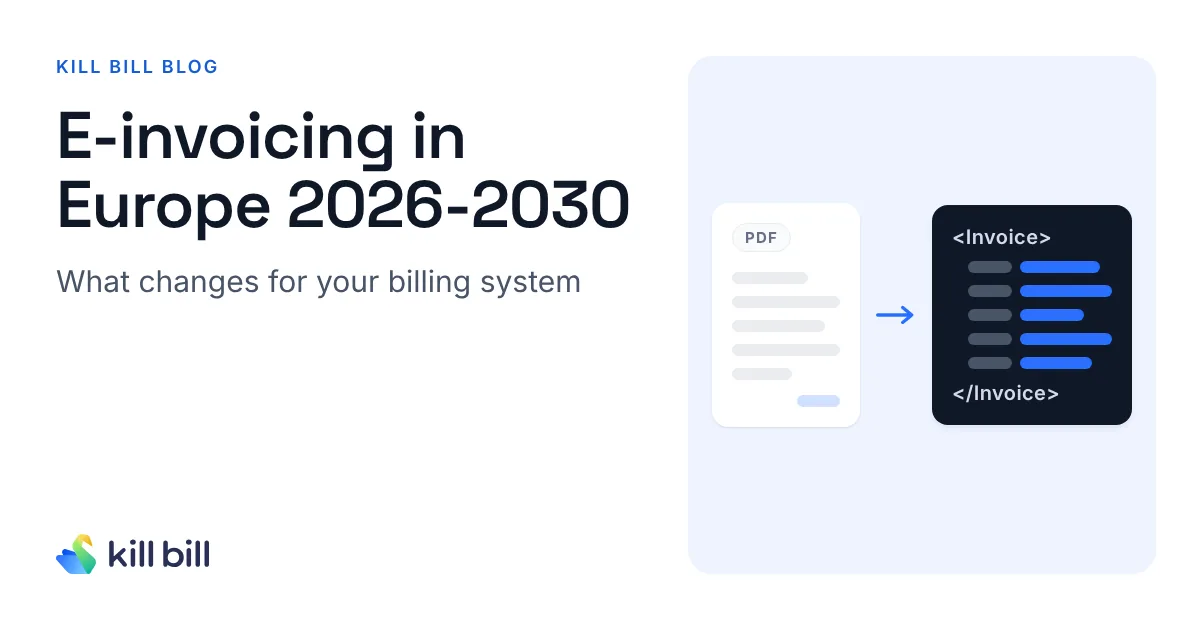
E-invoicing in Europe is the country-by-country shift from PDF or paper invoices to structured invoice files, mostly built on the European standard EN 16931, sent through a government platform, an approved platform or the Peppol network.
Across Europe, the legal invoice is becoming a structured data file that a tax platform or a network receives, checks and sometimes approves. For a billing system, this means stricter rules on data, numbering, corrections and archiving, plus a connection to an outside platform, country by country, between now and 2030.
Key takeaways
- As each mandate takes effect, the legal invoice becomes a structured file sent through a defined channel; a PDF sent by email stops being the legal invoice for transactions in scope. Hybrid formats such as Factur-X and ZUGFeRD combine a readable PDF with the structured file.
- Belgium, Croatia, Poland and France started in 2026; Germany requires larger companies to issue from 2027 and all companies from 2028; Spain requires B2B e-invoicing from October 2027 for larger businesses and from October 2028 for all others; the United Kingdom has announced April 2029; the EU adds cross-border digital reporting from 1 July 2030.
- Teams typically check: complete master data, controlled numbering, frozen issued invoices, exact tax lines, transmission, with status handling where the model requires it, and an archive of the issued file.
E-invoicing in Europe: the PDF invoice is ending, country by country
Italy moved domestic B2B invoices to a central platform in 2019. Belgium followed on 1 January 2026. Poland started in February 2026, and France on 1 September 2026. Germany requires larger companies to issue e-invoices from 2027. Spain has rules for billing software (Verifactu) and a B2B e-invoicing mandate from October 2027. At EU level, the VAT in the Digital Age package adds cross-border digital reporting from 1 July 2030.
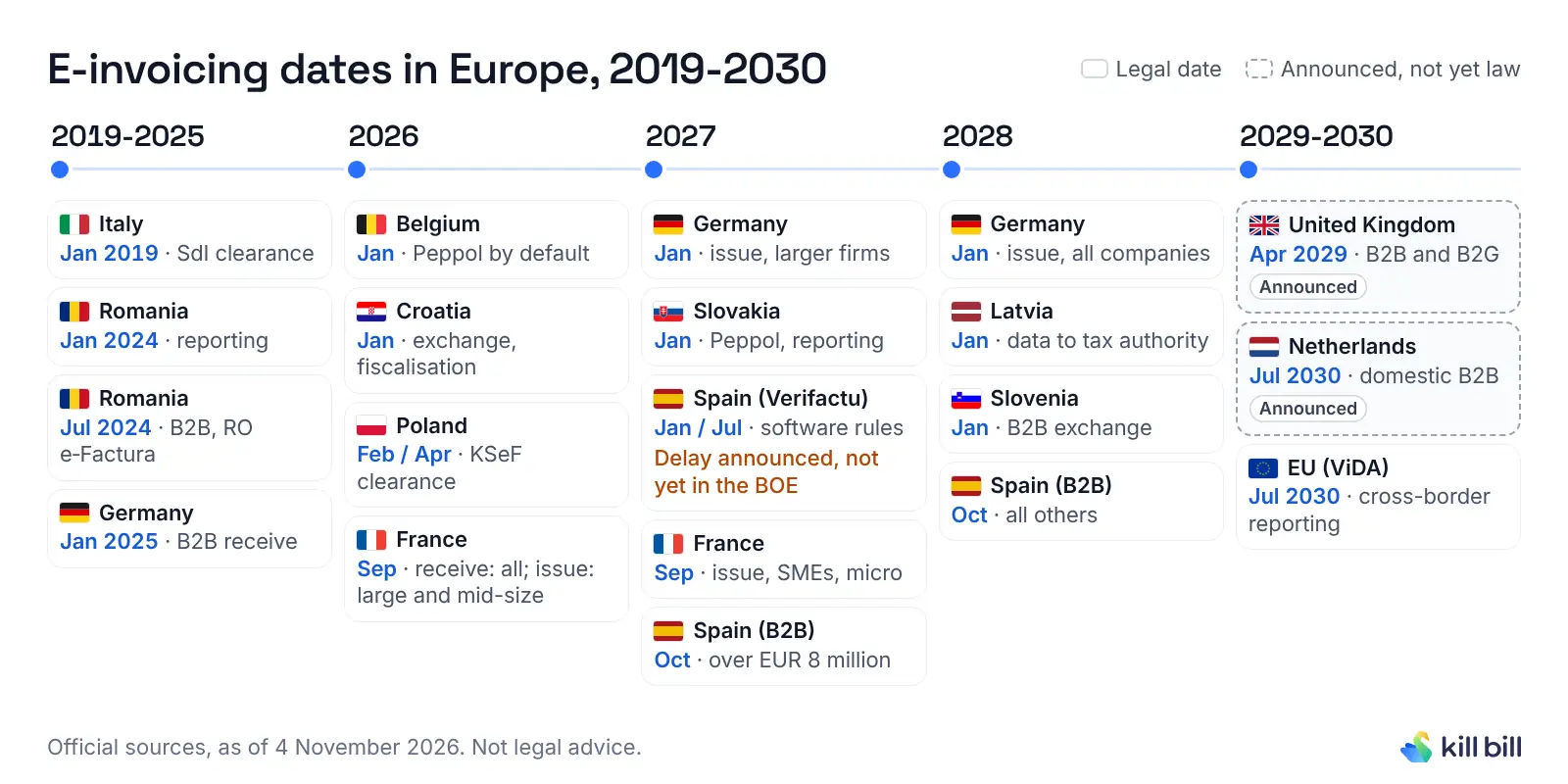
As each mandate takes effect, a PDF sent by email stops being the legal invoice for the transactions in scope. The legal invoice is a structured file, in a defined format, sent through a defined channel.
Most of the discussion so far is about tax and ERP systems. Less is written about the billing system, which is often where the invoice is created. That is the focus of this article.
This article describes what the rules say and what teams typically check. It is not tax or legal advice. Check your own obligations with your tax adviser.
Seven e-invoicing requirements for your billing system
1. The invoice becomes data, not a layout
The European standard EN 16931 defines the content of an e-invoice. Countries use formats built on it or next to it, mostly in the UBL and CII syntaxes: UBL, CII and Factur-X in France, XRechnung and ZUGFeRD in Germany, Peppol BIS in Belgium, FatturaPA in Italy, FA(3) in Poland. Your billing system has to hold every field these formats need, in a form that a converter can map without guessing. A template that only prints text is not enough.
2. Master data must be complete before issuance
Structured formats reject invoices with missing data. Typical gaps are the buyer’s VAT number, company identifiers, addresses split into fields, and mandatory legal mentions. These belong in validated fields on the customer account, not in free-text notes. Run the check before the invoice is committed, not after a platform rejects it.
3. Numbering is a legal control
Invoice numbers must identify each invoice uniquely and run in one or more series (in Germany, section 14(4) No. 4 UStG). Some countries set stricter rules for series and for corrective invoices; check each country. A number that can be edited after issuance, or a gap nobody can explain, will raise questions in an audit.
4. Issued means frozen
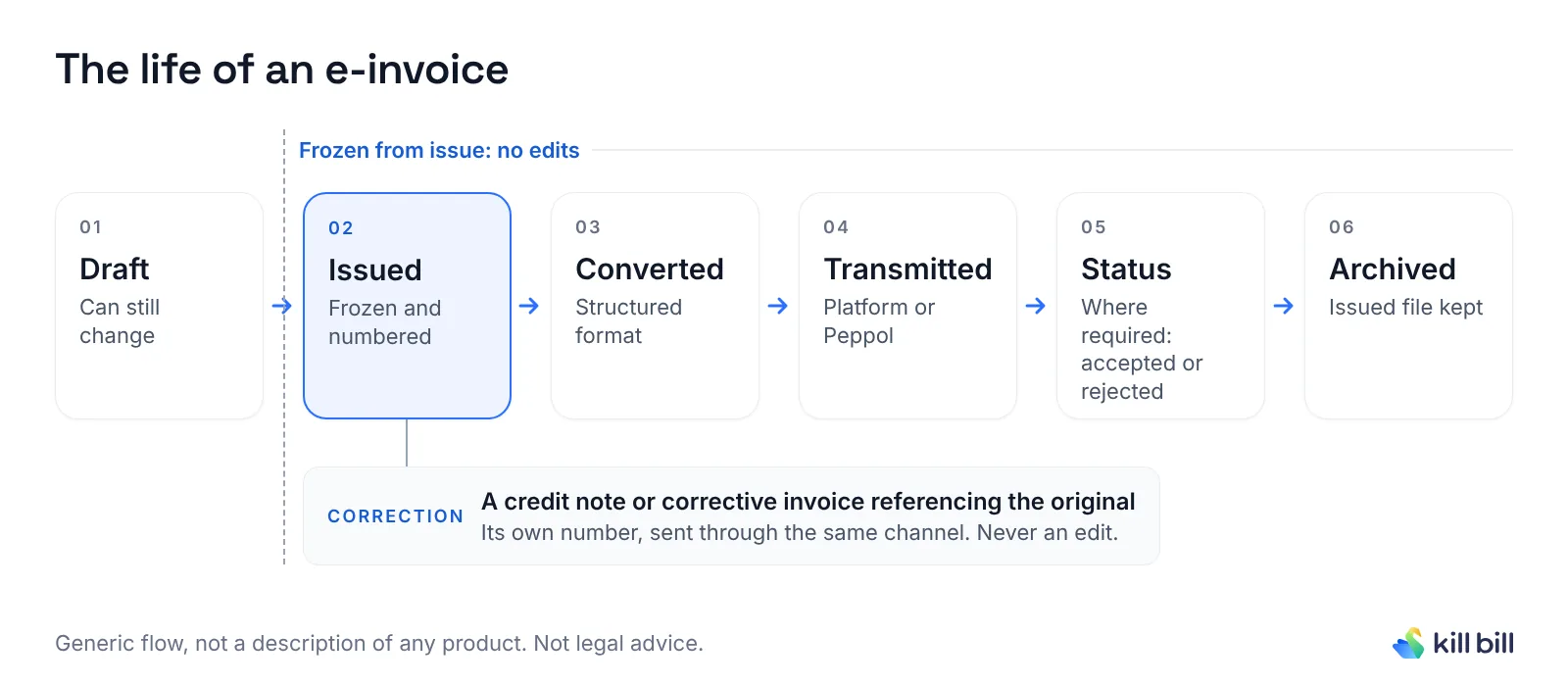
Once an invoice is issued, it does not change. A correction is a new document: a credit note, or a corrective invoice that references the original. The billing system needs a clear line between draft and issued, and an audit trail of each action.
5. Tax lines must be exact and explicit
Structured formats carry tax per VAT category, and the totals must add up. Under EN 16931 rule BR-CO-17, used in Peppol, the VAT amount for each VAT category is calculated on that category’s taxable total times its rate, rounded to two decimals. Reverse charge and exemptions need a stated reason, not just a zero amount.
6. Transmission and status join the invoice flow
In clearance models such as Italy (SdI) and Poland (KSeF), the invoice goes through a government platform. In France, it goes through an approved platform. In Belgium, it travels over the Peppol network. In clearance models and in France, the invoice gets a status, such as accepted or rejected. The billing system, or the system next to it, has to send the file, receive the status and handle a rejection.
7. The archive is the issued file
Many billing systems rebuild a PDF on demand from the current template. If the template changes, the copy changes too. Under the new rules, the document to keep is typically the file that was issued and sent. In Germany, for example, issuers must keep a copy of each invoice for eight years (section 14b UStG), and according to the Federal Ministry of Finance guidance on e-invoices and the bookkeeping rules (GoBD), the structured part is kept in its original form. Spain’s rules for billing software (Royal Decree 1007/2023, known as Verifactu) set requirements for the software itself: billing records are linked in a hash chain, they are also signed when the software does not send them to the tax agency, and invoices carry a QR code.
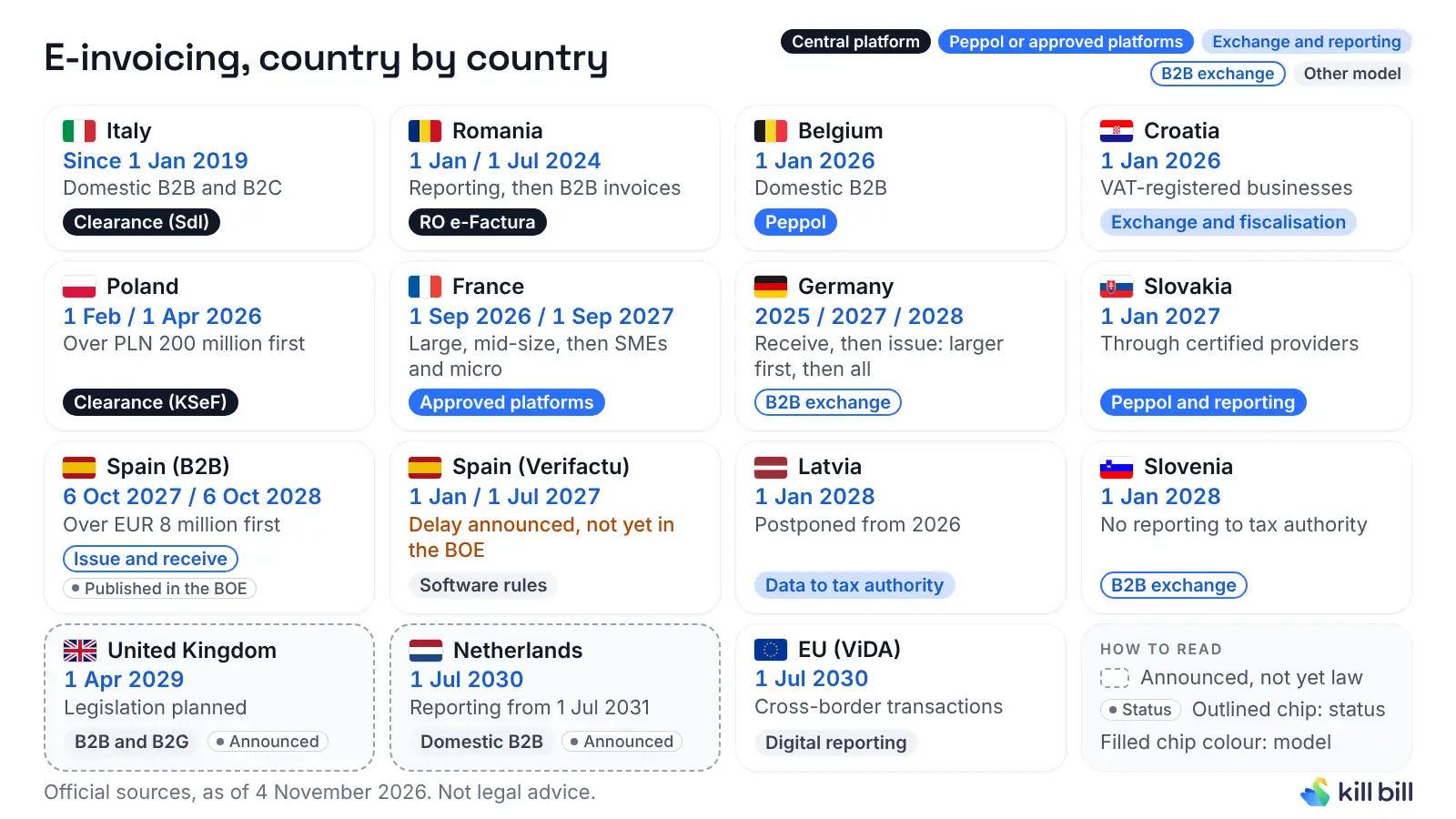
E-invoicing timeline by country, 2019-2030
| Country | Scope | Date | Official source |
|---|---|---|---|
| Italy | Domestic B2B and B2C, issue and receive through SdI (clearance) | Live since 1 January 2019 | Agenzia delle Entrate |
| Romania | Domestic B2B invoices through the national RO e-Factura system | Reporting from 1 January 2024; B2B invoices sent through RO e-Factura since 1 July 2024 | Ministry of Finance |
| Belgium | Domestic B2B, issue and receive, Peppol by default | 1 January 2026 | FPS Finance |
| Croatia | Domestic B2B structured e-invoices (eRačun) through intermediaries, plus fiscalisation reporting to the Tax Administration | 1 January 2026 for VAT-registered businesses; businesses outside VAT receive from 2026 and issue from 1 January 2027 | Porezna uprava |
| Poland | Issue and receive through KSeF (clearance) | 1 February 2026 for companies whose 2024 sales, VAT included, exceeded PLN 200 million (receiving through KSeF applies to all from that date); 1 April 2026 for other taxable companies; until the end of 2026, companies invoicing up to PLN 10,000 a month may still issue outside KSeF | MF |
| France | Receive through approved platforms (all companies); issue and e-reporting | Receive: 1 September 2026 for all companies. Issue and e-reporting: 1 September 2026 for large and mid-size companies; 1 September 2027 for SMEs and micro-enterprises | impots.gouv.fr |
| Germany | B2B receive, then issue | Receive since 1 January 2025; issue from 1 January 2027 for companies whose total turnover in 2026 exceeded EUR 800,000; all companies from 1 January 2028 | BMF |
| Slovakia | Domestic B2B e-invoices over Peppol through certified providers, with selected data sent to the Financial Administration | 1 January 2027 | Financial Administration |
| Spain (B2B e-invoicing) | Issue and receive B2B e-invoices (Royal Decree 238/2026, BOE 31 March 2026; Order HAC/1028/2026 in force since 6 October 2026) | 6 October 2027 for businesses with annual operations above EUR 8 million; 6 October 2028 for all others | BOE |
| Spain (Verifactu) | Requirements for billing software (not an e-invoicing mandate) | 1 January 2027 for corporate tax payers; 1 July 2027 for others (legal dates in force; on 5 October 2026 the Ministry of Finance announced a postponement to October 2028, not yet published in the BOE) | AEAT |
| Latvia | B2B e-invoicing with invoice data sent to the State Revenue Service | 1 January 2028 (postponed from 2026) | Ministry of Finance |
| Slovenia | Domestic B2B e-invoice exchange, no reporting to the tax authority | 1 January 2028 | Official Gazette |
| United Kingdom | B2B and B2G VAT invoices, issue and receive (announced; legislation planned) | 1 April 2029 | HMRC |
| Netherlands | Domestic B2B e-invoicing, then reporting (government intention, not yet law) | Announced on 11 September 2026: 1 July 2030, reporting from 1 July 2031; bill expected before summer 2027 | Government of the Netherlands |
| European Union (ViDA) | Cross-border digital reporting | 1 July 2030 | European Commission |
Portugal has no B2B mandate date yet; until 31 December 2026, PDF invoices are still accepted as electronic invoices for tax purposes. Dates move: the table reflects official sources as of 4 November 2026.
Common e-invoicing traps in billing systems
Credit notes treated as negative payments
In most formats, a credit note is a document in its own right. It needs a number, a reference to the original invoice, a tax breakdown and the same transmission. A refund recorded only in the payment system leaves nothing on the invoice side.
Edits instead of corrections
Changing an amount or an address on an issued invoice breaks the link between what the buyer received and what you keep. Once the file has gone to a platform, an edit in the billing system does not change what was sent. Issue a credit note and, if needed, a new invoice.
Numbering gaps and editable numbers
Check when your system assigns the number: at draft or at commit. Check where it lives: in a controlled sequence or in a field anyone can edit. Check what happens to the sequence when a commit fails halfway.
Archiving the wrong thing
A rebuilt PDF is not the issued invoice. Keep the file that was sent, the platform status, and the link between the two, for the period each country requires.
Multi-entity setups
Each legal entity has its own VAT number, numbering series, country rules and often its own registration with a platform or access point. A configuration shared across entities makes it easy for one entity’s settings to end up on another entity’s invoices. Model each entity separately and test each one.
How to prepare your billing system for e-invoicing: a 90-day plan
- Find out which system issues the legal invoice today: the billing system or the ERP. Write it down for each entity.
- List every issuing entity and country. With your tax adviser, map each one to its rules and dates.
- Pick ten real invoices, including a credit note, a usage-based invoice, a multi-currency invoice and a reverse-charge case. Check that every field a structured format needs exists in your billing data.
- Review numbering: unique per issuing entity and series, assigned when the invoice is issued, never overwritten, and every gap explained.
- Write down your correction flow: what can change on a draft, and what needs a credit note.
- Decide where conversion and transmission happen: in the billing system, in the ERP, or through an access point or platform provider. Name one owner per entity.
- Agree with finance what you archive, where, and for how long.
What to ask your billing vendor
- Does the system hold every field the target formats need, in structured fields rather than free text?
- Are customer master data (VAT numbers, identifiers, split addresses) validated before an invoice is committed?
- How are invoice numbers assigned: per issuing entity and series, at issuance, with no edits and every gap explained?
- Is an issued invoice frozen, with corrections only through credit notes or corrective invoices that reference the original?
- Are tax lines broken down per VAT category, with exemption and reverse-charge reasons?
- Where do conversion and transmission happen, and how are platform statuses and rejections handled?
- Is the issued file archived as sent, with its status, for the period each country requires?
Frequently asked questions
Is a PDF invoice still valid in Europe?
It depends on the country and the transaction. As each mandate takes effect, a PDF sent by email stops being the legal invoice for the transactions in scope; the legal invoice is a structured file sent through a defined channel. Hybrid formats such as Factur-X and ZUGFeRD combine a readable PDF with the structured file.
When does Spain require B2B e-invoicing?
From 6 October 2027 for businesses with annual operations above EUR 8 million, and from 6 October 2028 for all others (Royal Decree 238/2026 and Order HAC/1028/2026). Separately, the Verifactu rules for billing software apply from 2027 under the law in force; a postponement to October 2028 was announced on 5 October 2026 but, as of 4 November 2026, not yet published in the BOE.
What is EN 16931?
The European standard that defines the content of an e-invoice. National formats such as Factur-X, XRechnung, ZUGFeRD, Peppol BIS, FatturaPA and FA(3) are built on it or next to it, mostly in the UBL and CII syntaxes. A new edition, EN 16931-1:2026, replaces the 2017 edition; check with your format provider or access point when your formats move to it.
When do German companies have to issue e-invoices?
All companies must be able to receive e-invoices since 1 January 2025. Issuing is required from 1 January 2027 for companies whose total turnover in 2026 exceeded EUR 800,000, and for all companies from 1 January 2028.
What is the difference between a clearance model and a Peppol-based model?
In clearance models such as Italy (SdI) and Poland (KSeF), the invoice goes through a government platform and gets a status. In Belgium, the invoice travels over the Peppol network. Some countries, such as Slovakia, combine Peppol with reporting to the tax authority.
How do you correct an issued e-invoice?
Generally, you do not edit it. You issue a credit note or a corrective invoice that references the original, and send it through the same channel. The exact correction rules depend on the country.
Where we stand
Kill Bill is an open-source billing engine with a plugin architecture and a REST API. This article is vendor-neutral: it does not describe Kill Bill or Aviate features. If you are planning e-invoicing work around your billing system, talk to us: we can go through your entities, countries and invoice flows, and where the work could sit in your architecture.
Sources
- European Commission, VAT in the Digital Age (ViDA): https://taxation-customs.ec.europa.eu/taxation/vat/vat-digital-age-vida_en
- Council Directive (EU) 2025/516: https://eur-lex.europa.eu/legal-content/EN/TXT/?uri=CELEX%3A32025L0516
- France, Ministry of Economy: https://www.economie.gouv.fr/tout-savoir-sur-la-facturation-electronique-pour-les-entreprises
- France, impots.gouv.fr practical guide: https://www.impots.gouv.fr/sites/default/files/media/1_metier/2_professionnel/EV/2_gestion/290_facturation_electronique/guide_pratique_facturation_electronique.pdf
- Germany, Federal Ministry of Finance, E-Rechnung FAQ: https://www.bundesfinanzministerium.de/Content/DE/FAQ/e-rechnung.html
- Spain, Agencia Tributaria, Verifactu: https://sede.agenciatributaria.gob.es/Sede/iva/sistemas-informaticos-facturacion-verifactu/preguntas-frecuentes/huella-hash.html
- Spain, BOE, Real Decreto-ley 15/2025: https://www.boe.es/diario_boe/txt.php?id=BOE-A-2025-24446
- Spain, BOE, Royal Decree 238/2026: https://www.boe.es/diario_boe/txt.php?id=BOE-A-2026-7295
- Spain, BOE, Order HAC/1028/2026: https://boe.es/buscar/act.php?id=BOE-A-2026-20587
- Spain, Agencia Tributaria, B2B e-invoicing calendar: https://sede.agenciatributaria.gob.es/Sede/iva/factura-electronica/calendario-implantacion.html
- Spain, Agencia Tributaria, Verifactu deadline note: https://sede.agenciatributaria.gob.es/Sede/iva/sistemas-informaticos-facturacion-verifactu/nota-informativa-ampliacion-plazo-adaptacion-facturacion.html
- Romania, Ministry of Finance, RO e-Factura: https://mfinante.gov.ro/en/web/efactura
- Croatia, Tax Administration: https://porezna-uprava.gov.hr/hr/izdavanje-i-primanje-eracuna-i-fiskalizacija-eracuna/8047
- Slovakia, Financial Administration, e-invoicing FAQ: https://www.financnasprava.sk/_img/pfsedit/Dokumenty_PFS/Zverejnovanie_dok/Aktualne/DPH/2026/2026.09.15_eFak_FaQ.pdf
- Latvia, Ministry of Finance: https://www.fm.gov.lv/lv/jaunums/obligatie-e-rekini-visiem-uznemumiem-bus-jaievies-no-2028gada
- Slovenia, Official Gazette (ZIERDED): https://www.uradni-list.si/glasilo-uradni-list-rs/vsebina/2025-01-3032
- Netherlands, Government announcement: https://www.rijksoverheid.nl/actueel/nieuws/2026/09/11/kabinet-kiest-voor-invoering-e-facturatie-en-rapportage-voor-bedrijven
- Portugal, Tax Authority newsletter: https://info.portaldasfinancas.gov.pt/pt/at/Divulgacao/publicacoes_internas/Newsletter_AT/Documents/Newsletter-39-janeiro-2026.pdf
- Spain, Ministry of Finance, Verifactu note: https://www.hacienda.gob.es/sgt/gabsehacienda/nota-informativa-verifactu.pdf
- Italy, Agenzia delle Entrate: https://www.agenziaentrate.gov.it/portale/aree-tematiche/fatturazione-elettronica/guida-fatturazione-elettronica/la-fattura-elettronica
- Belgium, FPS Finance: https://einvoice.belgium.be/en/FAQ/general-questions-b2b
- Poland, Ministry of Finance, KSeF: https://ksef.podatki.gov.pl/informacje-ogolne-ksef-20/zakres-obowiazkowego-ksef/
- United Kingdom, HMRC roadmap: https://www.gov.uk/government/publications/e-invoicing-implementation-roadmap/roadmap-for-e-invoicing-implementation
- EN 16931, European Commission: https://ec.europa.eu/digital-building-blocks/sites/spaces/DIGITAL/pages/467108661/European+Standard+and+Specifications
- Peppol BIS Billing 3.0, rule BR-CO-17: https://docs.peppol.eu/poacc/billing/3.0/rules/ubl-tc434/BR-CO-17/
Sources read on 3 and 4 November 2026.