
Over the past few years, we’ve had the chance to work closely with the team at ChaChing. It’s one of those collaborations that grew naturally over time through technical conversations, shared customers, and a common view of where billing infrastructure should go next. Until now, we simply never talked much about it publicly.
Last week, I had the privilege to spend two days in Miami with the ChaChing team, and it was the kind of visit that reminds you why we love working on infrastructure software.
Most of the time was spent exactly where you’d expect: on the engineering floor, surrounded by whiteboards, architecture diagrams, and laptops. We walked through ChaChing’s AWS-based multi-tenant architecture in depth, reviewing how they operate a managed platform built on Kill Bill open-source together with Aviate. The result is a hosted billing environment that gives companies access to the flexibility and power of Kill Bill without needing to run or operate the infrastructure themselves.
This is an important step in making the platform accessible to a broader audience.
For many companies today, the choice is often between two extremes. On one side, fully managed SaaS billing tools that are easy to start with but become very expensive as you scale. On the other, enterprise-grade infrastructure platforms that provide the flexibility you need but require significant operational expertise.
Our goal with this partnership is simple: bridge that gap.
Through ChaChing’s managed offering, companies can run production billing infrastructure built on Kill Bill and Aviate without having to build and operate the platform internally. This makes a powerful, extensible billing stack available to companies that previously would not have considered it.
During the sessions, we also aligned our technical roadmaps. One topic we explored in depth was revenue recognition, which we recently introduced (currently in beta). Revenue recognition is one of those capabilities that historically required heavy enterprise systems. Our objective is to make it much more accessible and integrated directly into the billing platform. If this is something your organization is interested in, we’re actively working with early adopters. Feel free to reach out!
Another topic that generated a lot of discussion was the role of AI in billing systems.
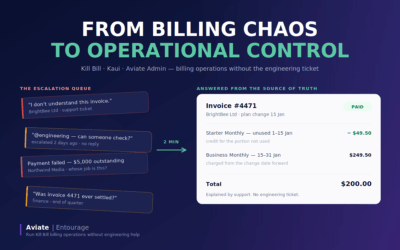
Billing platforms sit at the intersection of finance, operations, and customer experience. That makes them an interesting place for AI to assist humans, particularly in areas like pricing experimentation and billing anomaly detection. Imagine being able to explore pricing strategies faster, or automatically flag unusual billing patterns before they become real problems.
At the same time, billing systems cannot tolerate ambiguity. Invoices must be correct. Financial systems must be deterministic. That’s why we believe the right model is not replacing billing logic with AI, but augmenting backoffice workflows while keeping the core billing engine deterministic and auditable.
This balance between automation and reliability will be an important theme for billing platforms over the coming years.
Beyond the technical sessions, the visit was simply energizing. There’s something uniquely productive about being physically in the same room with engineers who care deeply about the systems they’re building. Architecture reviews turn into design debates, which turn into roadmap discussions, which then turn into entirely new ideas you hadn’t considered before.
By the end of the two days, we had aligned on several initiatives, refined parts of the roadmap, and identified a number of opportunities to make billing infrastructure both more powerful and more accessible.
If you’re interested in running Kill Bill as a managed platform, the ChaChing team is doing impressive work and would be happy to talk.